Tag Archive for: foundation

“Use Your Words”

At St. Paul’s Day School this is a phrase we say frequently.

Developmentally, children at age three have up to 1000 words in their vocabulary. Before this they are growing physically at an incredible rate, and they tend to respond to their wants and needs with actions instead of words. Those little muscles move quickly and get the attention desired. They’ve tested those physical responses and found that they are pretty effective at expressing their emotions. (‘Ever seen an 18-month-old arch their back and kick when you are trying to put them in the carseat?! They aren’t capable of saying, “Excuse me mother dear. I am quite tired and hungry, and I would not like to be buckled into this excessively warm carseat!”)
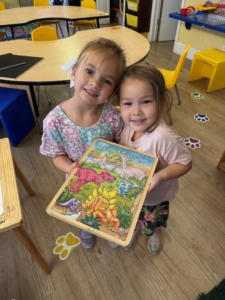
Once they’ve reached the age of three, they’ve developed more sophisticated verbal skills. But they need to practice making spoken words their response until it becomes a natural habit that is an even more effective form of communication. Sometimes they forget. They might swat a toy away from another child, or push them to get out of the way. We remind them that now that they are older, they have a powerful tool – and we often give them an appropriate example. “Can I play with that?” or even better, “Can I play with that when you are done?” Sometimes the response from the other child (who isn’t feeling threatened because the question was simple and straightforward) is a quick “Sure. Here.” With the toy being handed over peacefully. Or we might remind a child to “say “Excuse me” and Billy will know you would like to go by.” The positive result proving to the child that words work!

Manners are taught this way as well. When a child demands something, we give them the proper way to ask politely. “May I please have another strawberry?” and after receiving said strawberry… “Thank you!” I must confess that having worked with young children for so many years, my inclination is to provide “kind words” to everyone who needs them. From the young, to the “not so young.” My husband was even the recipient of a reminder several years ago, “why thank you dear wife.” Using good manners isn’t automatic. It’s a skill learned by imitating our role models, being given an example and practicing. We’ll model good manners and kind words here at St. Paul’s Day School, and do our very best to help your child “use their words” successfully!

Pro Tip from Mrs. Ryan

If you want to help your child practice their verbal skills you can play a game! Pick up a couple of their favorite stuffed toys. One will say things the right way “May I please have a cookie?”, and one does things the wrong way (the toy “grabs” the imaginary cookie from the “kind toy”. Ask your child, “which one did made a “thumbs up” or “kind” choice? And talk about it! It’s easier for your child to recognize positive and negative choices when it’s the behavior of their toy!
Why is Preschool so Important?

I am often told, “it must be nice to have a job where you can just play with little ones all day!” My response is always a smile. And, a gentle explanation of why it’s so important for a child to have a solid early childhood education.

During the time a child is in preschool, from 3  to 5 years old, their body and brain are developing quickly. Synapses and bones and muscles rapidly becoming stronger, more efficient, preparing for the tasks of learning to come.

These children are developing language skills, reasoning, problem solving and a complex cognitive understanding of the world around them. They go from a toddler who tumbles over the “roses in the rug” and who puts everything in their mouth to figure it out, to an explorer who ponders the why’s and how’s of everything they experience.

Things we take for granted are important ways the early childhood educator provides the foundation for a child’s lifelong learning.

We read books. We read to teach our small charges that letters have names and sounds and that they are different than numbers. That if you put the letters together, they make words and that when you put the words together, they make sentences that tell us a story. And that all of those letters and words go left to right! We expand their minds with vocabulary they haven’t heard before and ideas that are new and interesting. They learn to hold books, to turn pages and to appreciate humor and mystery and the thrill of a surprise ending!

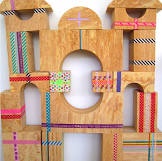
We build with blocks. And that teaches a child about math, spatial properties, physics and social interactions. They begin to understand counting, sorting, size comparison, patterning, and geometry! They start recognizing concepts like balance, symmetry, weight, and dimensions. They use scientific reasoning when they experience cause and effect and the force of gravity.

We color with crayons. Strengthening little hands and improving fine motor skills is essential to the ability to write. When they choose colors and make decisions about how their art will look, they learn to plan. These little scholars learn to deal with challenging feelings when their picture doesn’t look the same on the paper as it does in their mind. They are focusing for longer periods of time, improving hand eye coordination and attention span.

We use our imaginations. When the children enter the dress up area, they become a parent, a pilot, a chef, a princess, a doctor, and all sorts of other exciting characters. Each different role includes the ability to use their memory of the behaviors of each character. To use vocabulary that is particular for that play scenario. They learn to work with friends and play cooperatively. They practice their conversational skills and social emotional regulation.

Phew! That’s a lot in a simple day of play! Without it, without the stimulation of their amazing and incredible brains and exercising their growing muscles and bones, they fall far behind their peers. Their love of learning doesn’t develop. And there is no solid foundation to build on for the future.

That’s why preschool is so important. Why St. Paul’s Day School is so important. As Mr. Fred Rogers so famously said, “Play is often talked about as if it were a relief from serious learning. But for children play is serious learning. Play is really the work of childhood.”


Pro Tip from Mrs. Ryan:

Want to help your child remember your phone number or address? It’s really important information if they need help. Sing it! Children learn the words to songs much more rapidly than they do spoken words.  So use a “piggyback” tune (Row, Row, Row Your Boat, Twinkle Twinkle Little Star, London Bridge is Falling Down etc.) and sing the words!