
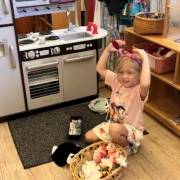
Let’s Play!
Why Free Play is an Essential Part of a Successful Early Childhood Program
Free Play. It’s not a time when the teacher is “on break” and the kids are running around going crazy. Free play is a developmentally necessary time that is an unstructured, child-led, and self-directed activity when children choose what to do, what materials to use, and how to play without adult-imposed rules or direct instruction. That said, the adult, be it parent or teacher, is right there using open ended questions to stimulate the child’s ability to plan, invent, problem solve, build vocabulary and strengthen fine and gross motor skills.
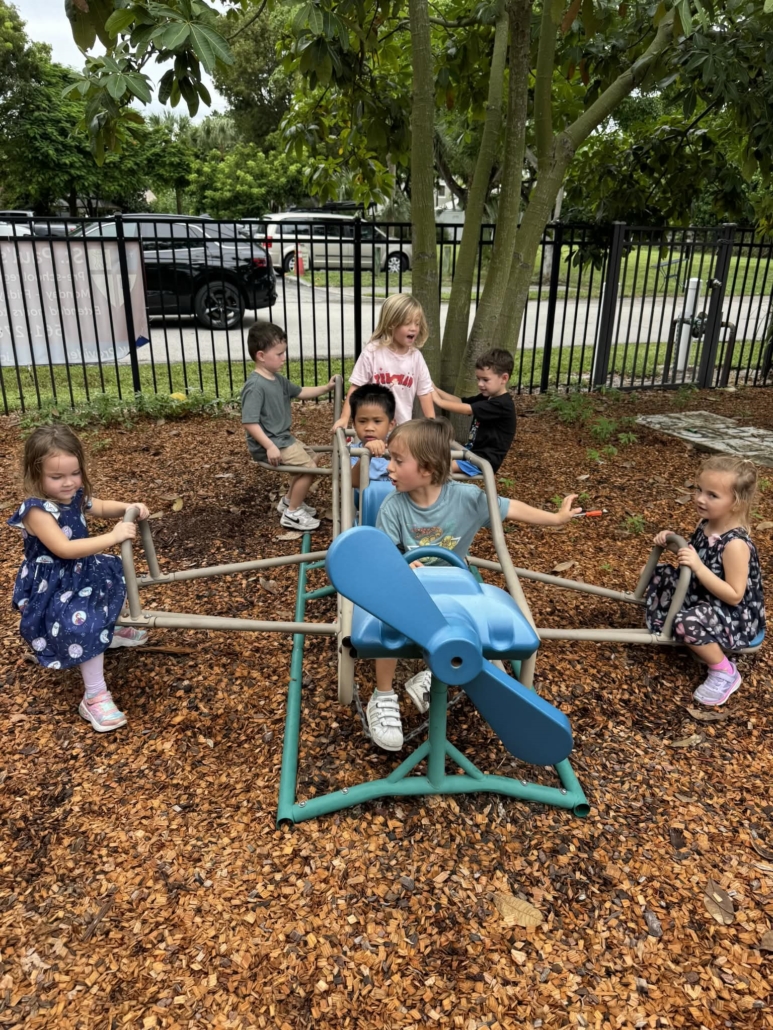
What does that look like?
A child building forts out of pillows and blankets is using critical thinking skills to estimate how large the fort needs to be. And what sort of creatures live there. And why they go into the fort. They are learning the physics of building walls and supports. They are experiencing the forces of gravity and balance and tension. A new world is created with stuffed animals as a civilization.
Barbies and action figures are giving the child the opportunity to learn social emotional skills. The “characters” act out familiar scenarios and practice sharing, conflict resolution and using their imaginations.
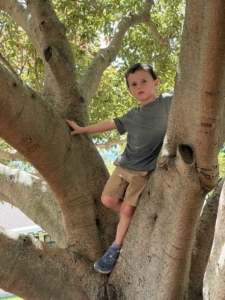
Outdoor free play includes running and climbing and exploring nature. Miniature “entomologists” examine insects as intently as any research scientist! They work on identifying, classifying and studying the behavior of their favorite “creepy crawlies”.
Artwork builds several skills, as children draw or paint they are strengthening little hands for more intense writing. They are using their creativity as they choose the media to express their feelings. They are identifying shapes and colors and how the picture is composed. When they draw with chalk, they are learning how much force it takes to make thin and thick lines. They discover the power of water as they make their chalk drawings disappear. They invent 3D sculptures with playdough, learning about structures and foundations and size.
These lessons learned through play create a network of neural connections or synapses which typically requires about 400 repetitions through standard drills. Learning and exploring through play can reduce that number to around 10 to 20 repetitions!
That’s why at St. Paul’s Day School, we make sure there is free play for at least half of our school day. Both indoor and outdoor. We play to learn!
Pro Tip from Mrs. Ryan
Confused as to what I mean when I say adults should expand upon a child’s learning experience by asking “open ended questions”? Any question that cannot be answered with “yes” or “no” works! Generally the sorts of questions children ask us… “Why?” “How?” “When?” “What?”


 important for a child to have a solid early childhood education.